04 / Paris-Dauphine · 2025
Customer segmentation decision dashboard
From clustering diagnostics to an interface a marketing team can actually explore.
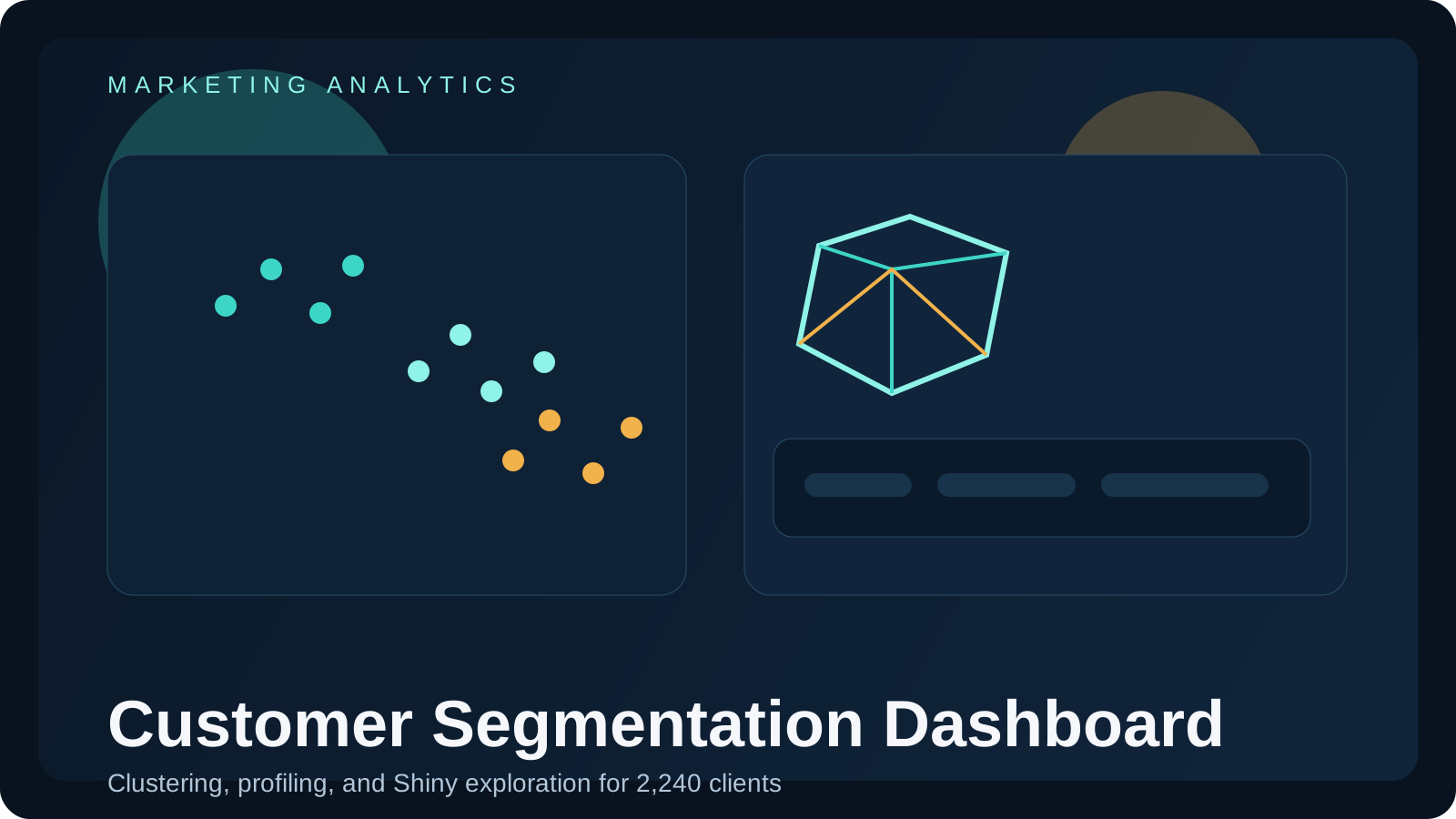
The work combines cleaning, feature engineering, K-means/CAH/GMM comparison and an interactive dashboard. The emphasis is not only on cluster labels but on the behaviors a stakeholder can inspect before designing a campaign.
Evidence register
2,240
customers
Behavioral and demographic observations
3
methods
K-means, hierarchical clustering and GMM
4
segments
Selected with elbow and silhouette diagnostics
01 / Problem
A single marketing message ignores meaningful differences in purchasing behavior, engagement, recency and channel preference.
02 / Approach
After cleaning and feature engineering, three clustering families are compared with internal diagnostics before the selected partition is translated into stakeholder-readable profiles.
03 / Outcome
The deployed Shiny dashboard supports filtering, PCA views, cluster sizes, radar profiles and re-running the selected clustering configuration.
System trace
How the evidence is produced.
Led data preparation, method comparison, interpretation and full Shiny dashboard implementation.
- 01Raw customer table → cleaning and features
- 02Scaled matrix → three clustering candidates
- 03Internal diagnostics → selected partition
- 04Segment profiles → interactive Shiny dashboard
Validation scope
Internal validation uses elbow, silhouette and Davies-Bouldin diagnostics. The current silhouette is approximately 0.35, indicating useful but overlapping groups.
Known limitation
The segments have not yet been validated through campaign uplift, temporal stability or out-of-sample assignment. They support exploration, not causal targeting claims.
What is inspectable
- The interface exposes both diagnostic and stakeholder views.
- Cluster descriptions connect behavior, recency, spending and channels.
- The live application is independently accessible without local setup.
Next proof to add
- 01Lock the R environment and add an automated Shiny smoke test.
- 02Measure cluster stability under resampling and across time windows.
- 03Validate campaign value through an uplift or controlled-experiment design.
Main stack